
South India is a treasure trove of ancient monuments and archaeological treasures. A fort has traditionally been, since the ancient times, a military establishment that served to protect the residing royal family that ruled the kingdom. With its many defenses, the fort was the quintessential structure that ensured peace and stability in a kingdom.
South India is particularly rich the number and type of forts found in the region. It is here that several beautiful forts belonging to the ancient and medieval periods are to be found as reminiscent of a bygone era. The reminders of a rich cultural legacy.
Take the Golconda Fort for example. The fort has superior ingenious acoustics built into its magnificent design. Just clap beneath the central dome and your sound could even be heard more than a kilometer away on a pavilion above- a great way to send across signals to alert military forces in the times of external attacks!
The Gingee fort in Tamil Nadu is another marvel of ancient architecture. The fort is one of India’s most inaccessible ones that have been praised for its impregnability since ages. Inside the fort are granaries, palaces, temples, and prison cells that instantly take onlookers back into the bygone era.
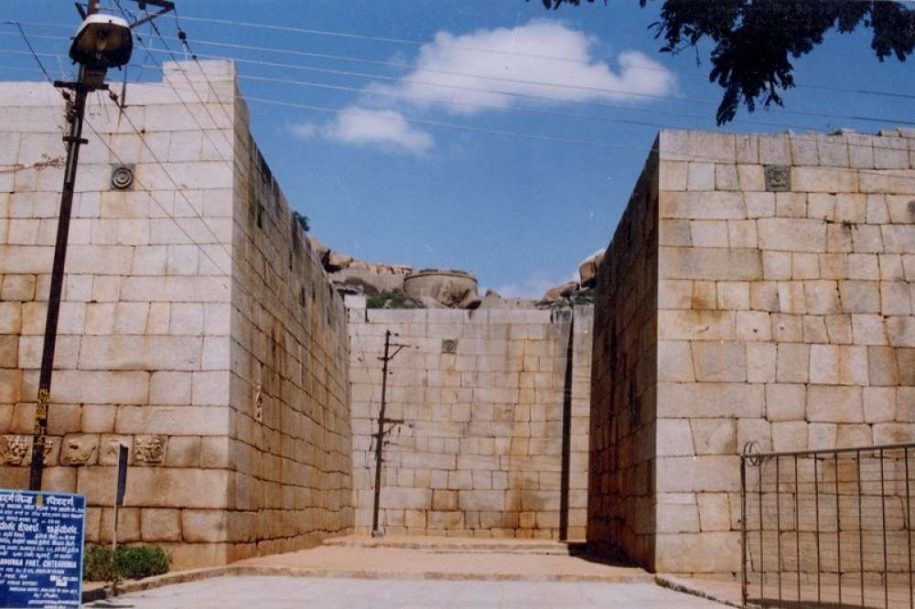
The South Indian state of Karnataka too abounds in beautiful forts and palaces. One of the state’s most beautiful forts is the Chitradurga Fort. The name itself narrates the epic saga of the ancient wonder: the word ‘Chitradurga’ comes from ‘Chitrakaladurga’ meaning ‘The Picturesque Fort’! The fort has had links with numerous powerful empires: Mauryan, Chalukyan, Hoysalas and the Vijayanagara.
The ancient fort is also linked with the Mahabharata, for the great Indian epic mentions the Chitradurga hill and its surrounding areas. It is said that the mighty warrior prince Bhima killed several rakshasas who once inhabited the region. An Ashokan rock edict found in the region, the Brahmgiri inscription links the fort with the Mauryan Empire.
The magic of the Chitradurga Fort spellbinds visitors: as many as seven concentric walls protect the fort that is home to 19 gateways, 35 secret passages, 2000 watchtowers, and water tanks! Such is the rich heritage and legacy of this incredible fort!
The fort’s walls echo the story of the legendary ‘Obavva’, a woman who saved the fort from an external attack with her presence of mind. Serving in her soldier husband’s position while he was away for a while, Obavva heard the enemies’ noises emanating from a crack in the wall as they tried to sneak in. She killed them all with an Onake, the paddy pounding rod as they emerged from the hole one by one.
The woman’s commendable act of bravery and supreme valor immortalized her in the folklore of the region for all times to come. A statue was installed in the memory of the woman. ‘Onake Obavva’ still echoes through the walls of the Chitradurga Fort.
The Bekal Fort in South India is another example of extraordinary ancient military architecture. The walls of the fort are equipped with multiple holes that enabled the soldiers to defend the structure in the event of external attacks.
The Bidar Fort in Karnataka is associated with the Bahmani Sultanate. The Chandragiri Fort in Andhra Pradesh is associated with the great Vijayanagara Empire ruler- Raja Kroshnadevaraya who, it is believed, grew up as a prince in the fort. The Kondaveedu Fort in the state is yet another example of the brilliance of ancient art and architecture.
Leave a Reply